
7 Things to Check Before Filing Your ITR
These simple tax filing checklists can help you avoid headaches later
Did your office conversations shift from ‘Who are you rooting for in the FIFA World Cup?’ to ‘Have you filed your taxes?’
Welcome, it’s that time of the year when tax filing becomes the hot topic. With only a few days left, the scramble to figure out your tax returns is in full swing.
The chart below shows the interest in Google searches for the topic ‘Income tax filing.’ Among them is the writer of this article, who is also trying to learn the ropes of filing his own taxes :-)
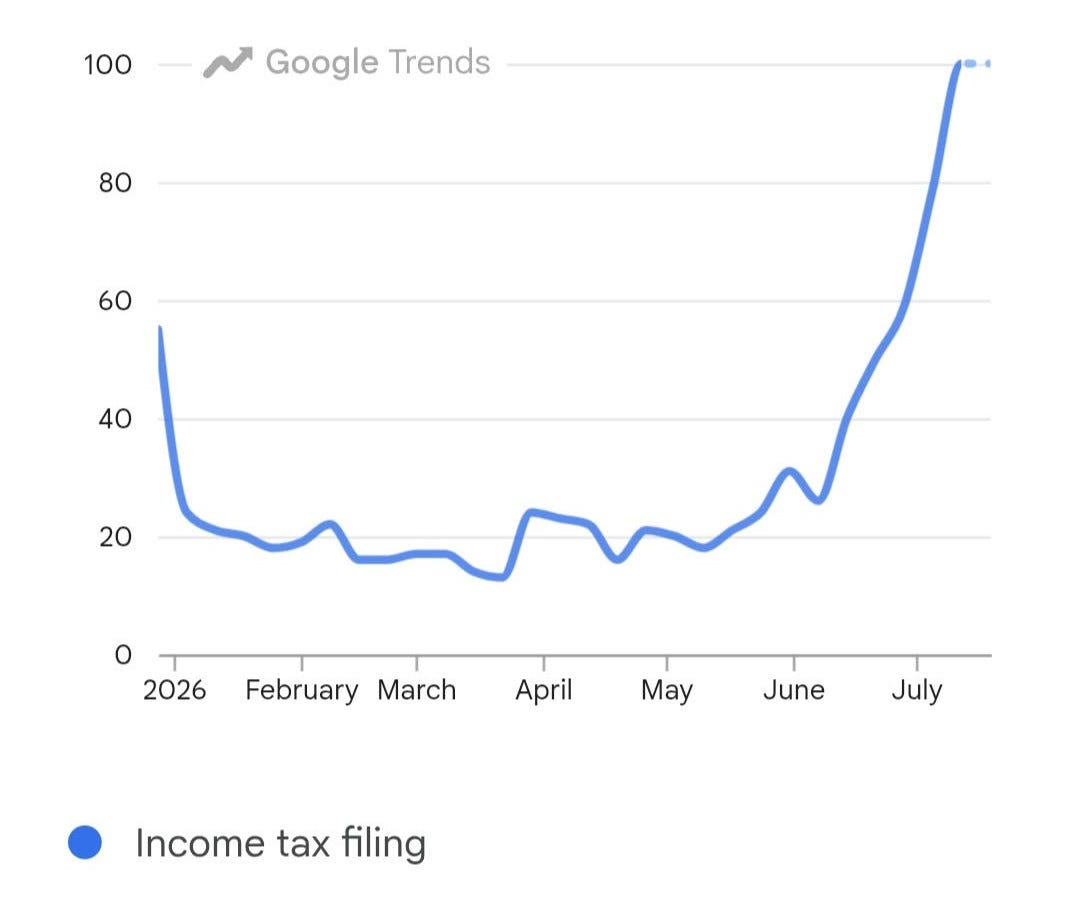
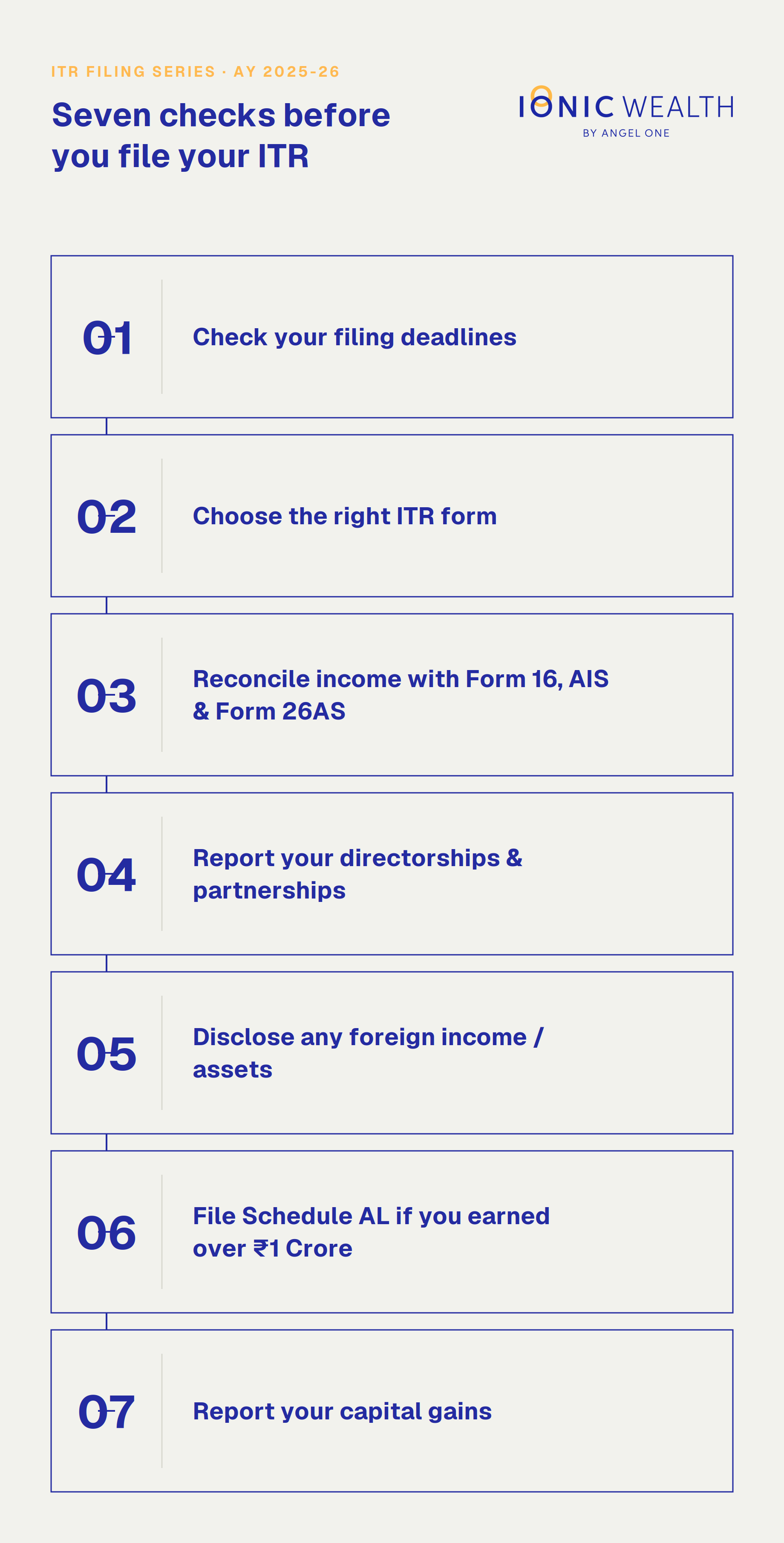
Since the writer is clearly not the only one interested in this topic, we connected with Ionic Wealth’s in-house tax lead and chartered accountant, Hardik Mehta, to put together a list of key points worth keeping in mind before filing this year’s income tax returns (ITR).
More often than not, high-net-worth individuals face a slightly more complex tax filing process, owing to their large and sometimes multiple sources of income, as well as exposure to different asset classes. We will try to simplify some of those requirements today.
Think of this as a bird’s-eye view, covering the broad points. That said, this article is not a magic wand that will make your tax issues disappear — but we hope it will help you sidestep a few landmines along the way.
Check your filing deadlines
Let's first address the elephant in the room: what happens if you don't file your income tax return (ITR) on time.
For most people, the last date for filing returns is 31st July. If you miss this deadline, here are your options. Belated returns can be filed till 31st December, but they come with a few conditions. You have to pay interest for unpaid taxes, along with a late filing fee of up to Rs 5,000 based on income level.
Taxpayers also have to stick with the default regime and cannot switch to the old regime, even if it is more attractive. Not to mention, capital losses cannot be carried forward to set off against future gains.
Now if you also happen to miss the belated return deadline, you can file an ‘Updated Return.’ However, you have to pay additional tax in the case of an updated return, over and above the original tax and interest.
It is based on how late the updated return is filed, measured from the end of the relevant assessment year:
25% additional tax — if filed within 12 months
50% additional tax — if filed between 12 and 24 months
60% additional tax — if filed between 24 and 36 months
70% additional tax — if filed between 36 and 48 months
The deadlines for various ITR forms are below:
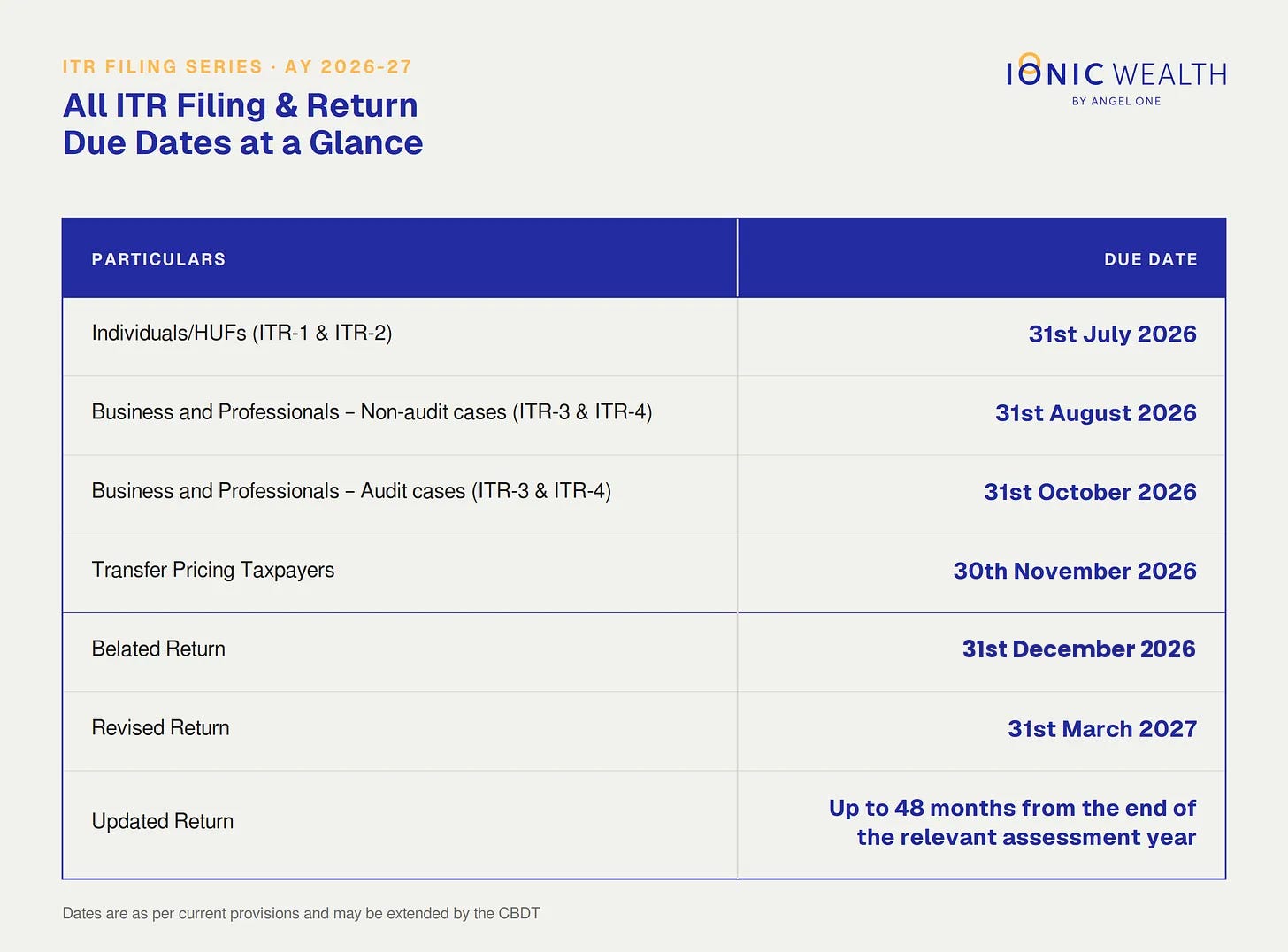
And if you filed your ITR on time but have entered incorrect information or omitted anything from your ITR, a revised return can be filed. It can be filed any number of times before 31st March 2027.
Choose the right ITR form
Now let’s dive in. The first step is to choose the right ITR form. This will broadly depend on (A) the nature of your income and (B) how much income you had during the financial year.
Individual taxpayers have four kinds of ITR forms to choose from, and selecting the right form isn’t too complicated. That said, if you get the first step incorrect, then your entire ITR will have gaps going forward.
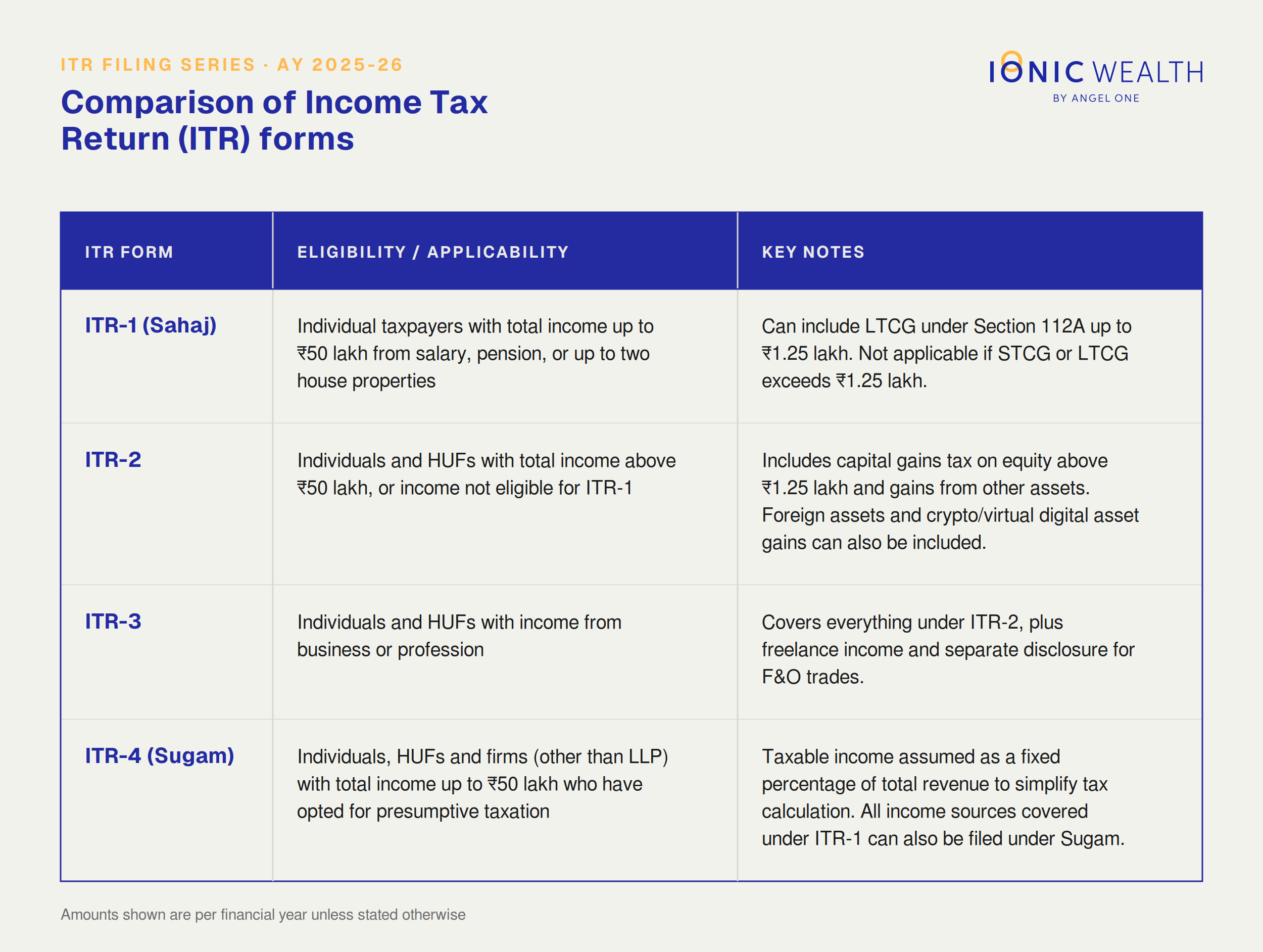
Reconcile income with Form 16, AIS & Form 26AS
All taxpayers have access to three documents that will help them accurately report their earnings and figure out how much tax they have to pay.
Form 16: The employer issues this, which includes the salary earned in the financial year, along with the tax deducted by the employer on it. In most cases, the HR department of the company sends this to employees before tax filing starts.
Form 26AS: It reflects income on which tax has been deducted or collected, along with other tax credits. This includes not just your salary, but other income sources too, such as bank interest, wherever TDS was applicable.
A critical difference between the two forms is that Form 16 is what the employer gives you for your records, while the government relies on the data reported in Form 26AS.
Watch out: Sometimes what the employer claims to have deducted as tax doesn’t always match the details reported in Form 26AS.
This usually happens due to a job change during the year, a delay by the employer in depositing the deducted TDS with the tax authorities, or simply a clerical error in the employer's TDS return. If you spot this mismatch, you can flag and rectify it before filing your ITR.
And then there is the AIS (Annual Information Statement). This includes all the transactions registered with your PAN for the financial year, including salary, bank interest, dividends, bonds, equity and MF transactions, etc.
You can check the AIS to see if any unexpected income shows up and rectify such mistakes if you spot them. You can check your Form 26AS and AIS on the IT portal website.
Report your directorships & partnerships
Reporting a directorship or partnership is mandatory in your ITR.
Details of directorship in a company are already available to the government via Ministry of Corporate Affairs (MCA) disclosures, so failing to disclose this in your ITR can easily be flagged by the IT department. When a directorship in a foreign company is involved, it’s even more important to disclose it, as failure to do so can attract scrutiny under the Black Money Act.
Disclose any foreign assets
Assets located outside India need to be reported in Schedule FA (Foreign Assets). Even if the asset was sold during the year, or if you are simply holding it without realising any gains, it still needs to be reported. If you fail to report foreign assets and income, and it catches the attention of the IT department, it can attract scrutiny under the Black Money Act, 2015, along with a heavy penalty.
One important point to note is that foreign asset reporting follows the calendar year, while the ITR follows the financial year for other income and disclosures.
For instance, if you held any foreign asset in January last year, that means it will have to be disclosed in this year’s Schedule FA, since foreign assets follow calendar-based reporting. For most other income and disclosures, the financial year is followed, from April 1st, 2025 to March 31st, 2026.
On the other hand, foreign income has to be reported in Schedule FSI (Foreign Source Income) along with the relevant heads it falls under, such as capital gains, interest or dividends.
Did you know? If you have paid tax on foreign income and want to set it off against tax payable in India, then Form 67 in the ITR has to be filed.
Also Read: How to add GIFT City Cat-3 funds in your ITR?
Earned over Rs 1 Crore? File Schedule AL
If you or your HUF earned more than Rs 1 crore between April 1, 2025 and March 31, 2026, you must also disclose your assets and liabilities in Schedule AL (Assets and Liabilities). This helps the tax department assess whether your assets are commensurate with your reported income.
This schedule has separate columns for each category of assets. One common mistake taxpayers make is reporting assets at the fair market value instead of their cost of acquisition. Schedule AL is intended to track how taxpayers acquired their assets, so the cost of acquisition should be reported.
Here are some handy notes:
Bank accounts – report the balance as of March 31, 2026
Loans – report the outstanding balance (not the original loan amount) as of March 31, 2026
Shares – if bought and sold within the financial year, they need not be included
Foreign assets must be reported in both Schedule AL and Schedule FA, where applicable. But Schedule FA follows the calendar year, while Schedule AL follows the financial year. As a result, although both schedules include foreign assets, the reported values may differ.
Report your capital gains
This one is important, and many people miss this in their tax filings. Capital gains are not pre-filled in the ITR, and the onus is on the taxpayer to disclose any capital gains earned during the year.
While other incomes are taxed as per slab rates, capital gains has its own special rates, barring a few exceptions.
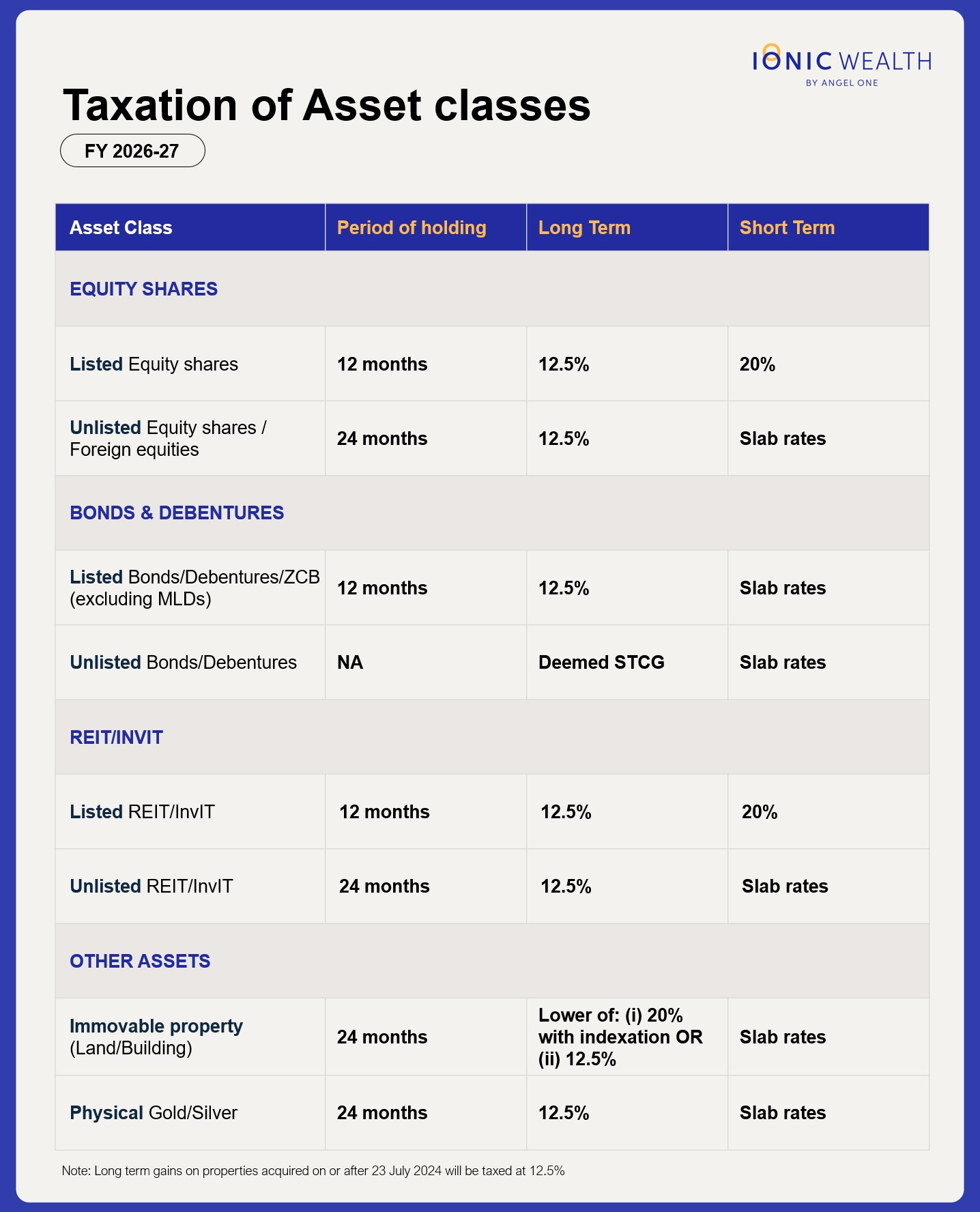
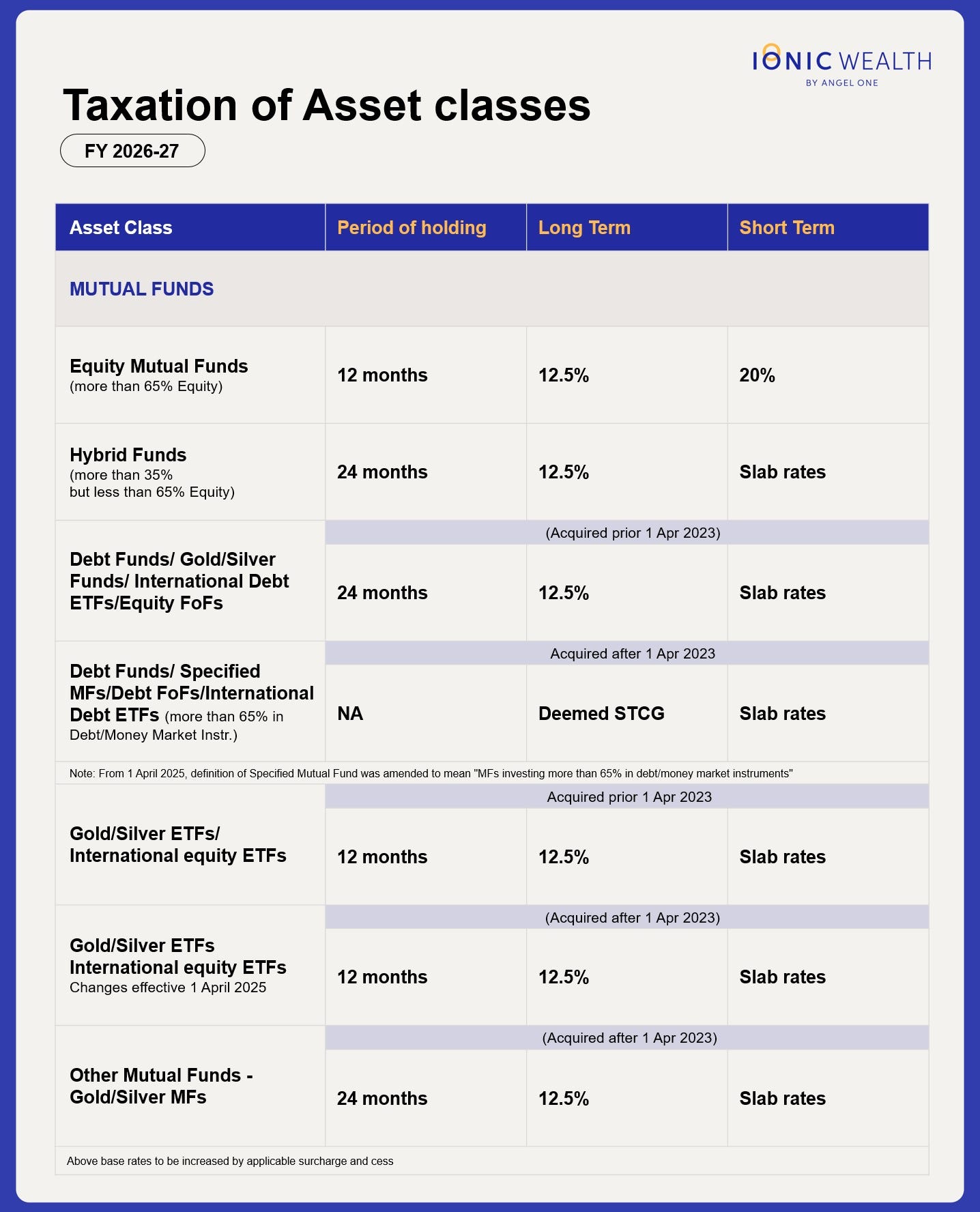
It also helps to know that different asset classes, holding periods, and dates of acquisition can result in different tax rates. For instance, debt funds acquired until 31st March 2023 are taxed at 20% plus indexation if sold after 3 years, and at slab rates if sold within 3 years. After 1st April 2023, all debt funds sold, regardless of the holding period, are taxed at slab rates.
Equity shares and equity-oriented MFs bought before 2018 also enjoy a grandfathering clause. This means that even if you bought shares in 2010, the cost of acquisition is taken as the FMV as of 31st Jan 2018, unless the original acquisition price is higher. This will help lower capital gains income and save tax for units acquired before 2018.
Sources for capital gains details:
Shares – details available from your broker’s console
Mutual funds – details available from the registrar’s statement
Property transactions – details available in the sale deed
Above a certain threshold, capital gains also require quarterly advance tax payments. Failing to do so can result in additional interest during ITR filing. Under Schedule CG, Part F can be used to check advance tax compliance.
Did you know? Capital losses should be included in the ITR, even if no tax is payable on them. They can be used to set off future gains for up to 8 assessment years. Failing to submit your ITR by the due date will disqualify the taxpayer from using the losses in the future.
There are many other aspects to cover, but to be honest, the writer's own ITR is still pending. With the clock ticking, it's time to wrap up this article and get that sorted with his CA's help. If you haven't filed yours yet, don't wait until the last-minute rush!
