
Does your portfolio need Copper?
A gap leaves Indian investors without copper exposure.
Silver is the best conductor of electricity, but if you open the plastic cover of wires around you, you will find copper inside.
While silver is technically the best conductor of electricity, it was simply too expensive. In the real world, copper was more reliable.
In short, that’s how the red metal became the backbone of many industries and sectors.
What happened after that is somewhat interesting. Over time, the red metal became good at predicting the overall health of the economy.
So when copper prices go up, analysts start taking it as a sign of an improving global economy. It usually means that industries are demanding more copper and anticipating more consumption. When it goes down, the opposite happens: it signals a weak economy.
In fact, Wall Street analysts gave the nickname 'Dr Copper' to copper for its ability to predict the economy. That’s why copper is commonly known as the only metal with a PhD in economics.
Current State
Right now, Dr Copper is at a crossroads. On one hand, copper demand is rising, but at the same time, the supply is shrinking.
Let’s first talk about demand. Beyond everyday use, copper is being increasingly used in new-age industries.
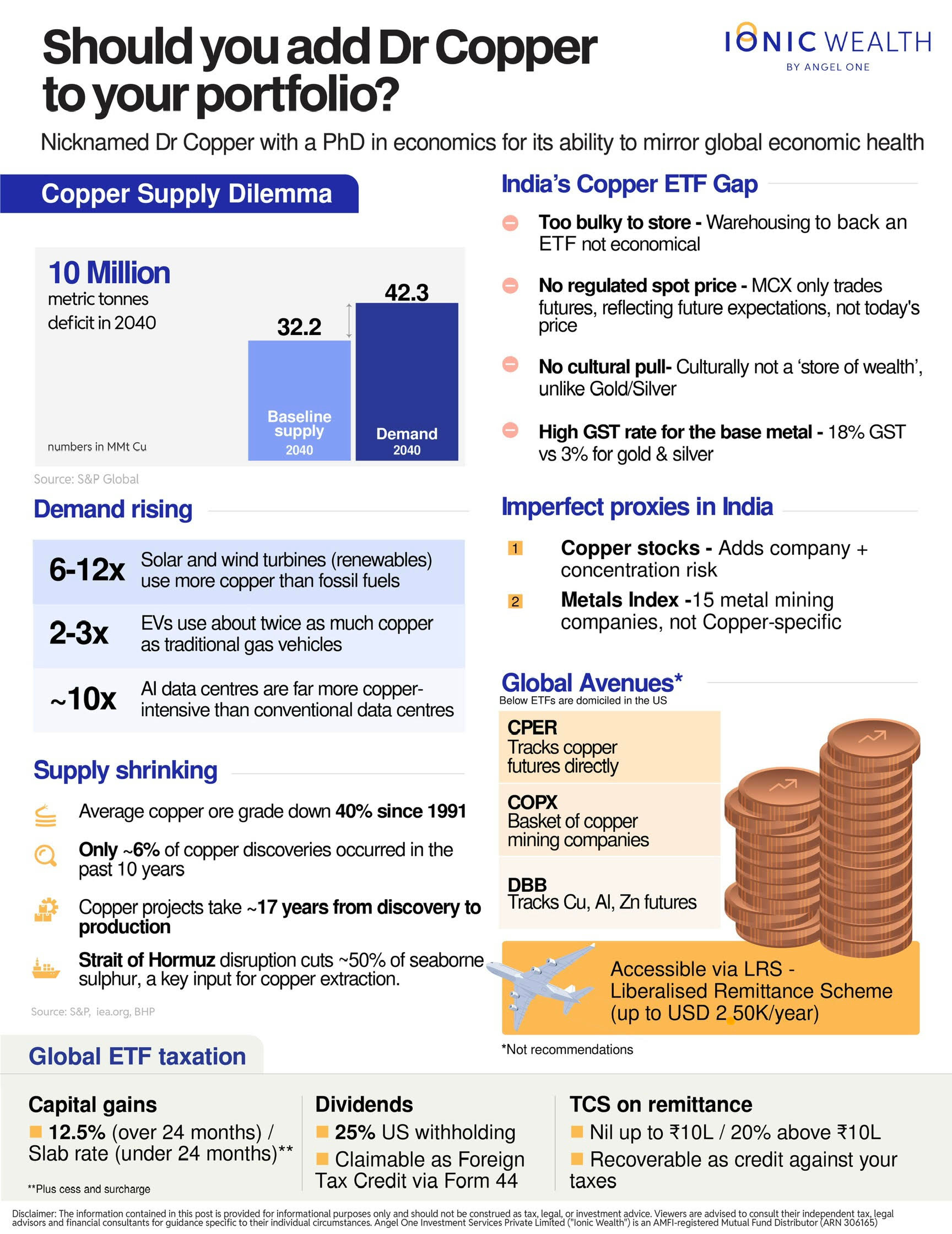
Renewable energy sources like wind, solar, and geothermal use up to 7 times more copper than fossil fuel-based power plants.
Electric vehicles need about 2.9 times more copper than traditional gas cars.
Hyperscale AI data centres can use up to 10 times as much copper as regular data centres.
As these new-age industries grow, so does the demand for copper. But that’s just half the story. What’s happening on the supply side is something to take notice of.
To begin with, the closure of the Strait of Hormuz has cut off roughly half the world’s supply of sulphur that is transported by sea.
Sulphur is required to make sulphuric acid, and this acid is commonly used to extract copper from copper ores. Think of them like rocks containing a tiny percentage of copper. Through a process called ‘heap leaching’, sulphuric acid is used to extract a small amount of copper from these copper ores.
With no fast alternative extraction method available, copper mines in Chile and Africa that depend on continuous sulphuric acid supply face shutdown within weeks of exhausting their existing inventory.
That said, the Strait of Hormuz is a short-term disruption. Over the longer run, the outlook deteriorates.
Ore grades have dropped 40% since 1991, meaning miners extract less copper from every tonne of rock.
New discoveries have dried up. Of all copper deposits found in the last 35 years, only 6% were discovered in the last decade.
Even when you do find a deposit, it takes an average of 17 years to go from discovery to actual production.
No surprise, then, that S&P Global forecasts copper production peaking at 33 million tonnes in 2030 against a total demand of 42.3 million tonnes. That translates to a 10 million tonne copper deficit by 2040, even after accounting for recycled copper.
Copper’s investment use case
The past year has been brutal for equity investors in India. Nifty 50 lost one per cent in the past 12 months (as of April 27, 2026). But there's one asset class that's been doing the heavy lifting — commodities — and they're barely on the retail investor's radar.
As of March 2026, Silver has delivered annualised returns of 79.18% over the past two years. Gold: 50.33%. Dr Copper gave a humble 20.08%. These returns are in dollar terms, and if you factor in the rupee’s depreciation, the numbers look even stronger.
But here’s the catch. India is effectively a two-commodity market: Gold and Silver ETFs. There’s no ETF for copper. No platinum ETF. No aluminium ETF.
Even if you believe in the copper story, it gets hard for you to get exposure to the copper via an ETF in India.
Storage issues. India’s gold and silver ETFs hold actual metal in regulated vaults. That’s fine, because gold and silver are high-value and easy to stash.
But copper is bulky and far less valuable per kg. The value of gold that can be stored in the size of a pea requires the equivalent of roughly 110 kg worth of copper bars to store the same value. Copper also easily gets oxidised, which makes it even more difficult and expensive to store.
Lack of regulated spot price. Any ETF needs a reliable, SEBI-approved benchmark to calculate what one unit is worth each day. While Gold and silver recently shifted to domestic MCX spot prices, copper doesn't have one for now.
MCX trades futures for copper, but futures reflect what the market expects the price to be in the future, not what it is today. Copper MCX volumes are also limited, and a lack of liquidity can lead to sharp price swings
MCX copper’s average open interest is around 26,000 metric tonnes. An ₹800-crore ETF would require positions equivalent to nearly one-third of this market, potentially distorting prices and increasing impact costs during monthly rollovers. Far-month contracts—essential for ETF stability—are thinly traded.
Moreover, only about 21% of MCX copper participants are hedgers; most are short-term traders, limiting long-term liquidity. While linking the ETF to global exchanges like the LME or CME could solve this, current regulations do not permit such structures.
Source: Moneycontrol
High GST rates: While gold and silver attract a 3% GST, copper attracts an 18% GST rate. Creating a physical copper-backed ETF will bake in those high GST rates and drag down the investor’s returns.
Indian mindset. Gold and silver have centuries of cultural weight as stores of wealth. Copper, on the other hand, is what your wiring and plumbing are made of. Almost all copper trading on MCX today is done by institutions and speculators, not retail investors.
Where to find?
Domestically, your options are thin. One option is to directly buy copper stocks, but then you’re taking on company-specific risk. Or you can invest in the Nifty Metal Index, which is too broad and gives you a bundle of metal companies, not pure copper exposure.
Instead, investors may use their Liberalised Remittance Scheme (LRS) to get exposure to copper via US-listed ETFs. Commodity ETFs in developed markets are far more developed and more reliable tracks copper prices along with higher liquidity.
Three copper ETFs worth knowing about:
United States Copper Index Fund (CPER): Tracks copper futures directly. Pure copper price exposure.
Global X Copper Miners ETF (COPX): A basket of copper mining companies.
Invesco DB Base Metals Fund (DBB): Diversified exposure to copper, aluminium, and zinc.
How to structure your portfolio
Copper has earned its place alongside gold and silver, not as a replacement, but as a complement. The long-term demand story is hard to argue with: The world needs more copper for electrification, and supply is just not keeping up.
But copper is a cyclical industrial commodity and not the best store of value. Investors may use copper as a satellite position in their portfolio. Volatility will also be significantly higher than gold.
For Indian investors, the playbook is simple: use domestic ETFs for gold and silver, use LRS for copper. Stay disciplined and don’t chase the rally. Build the position over time.
Lastly, Investors should also note that US estate taxation is applied to US assets held by Indians. It means that upon death, a non-resident of the US (like Indians) needs to pay up to 40% as estate tax on US situs assets beyond $60,000.
With inputs from Ankita Pathak, Chief Macro and Global Strategist, Ionic Wealth.
Disclaimer: The information contained in this post is provided for informational purposes only and should not be construed as tax, legal, or investment advice. Viewers are advised to consult their independent tax, legal, and financial consultants for guidance specific to their individual circumstances. Angel One Investment Services Private Limited ("Ionic Wealth") is an AMFI-registered Mutual Fund Distributor (ARN 306165)