
Two pathways into India, one portfolio decision
What the investment structure actually means for your money

Meera and Vikram1 had been arguing about this for three months, though neither of them would call it an argument. It was more of a slow, recurring disagreement that surfaced every time money came up, which, in a dual-income household in Dubai with two school-age children, was often.
Vikram wanted to invest more aggressively in India. He had spent fourteen years in the UAE’s infrastructure sector, and his view was clear: India’s growth story was the best asymmetric bet available, and they were not allocated enough. Meera, who ran procurement for a logistics firm, agreed with the thesis but not the method. She had been reading about GIFT City. She wanted to understand why they were investing through an NRO account when there appeared to be a structurally different option they had never been shown.
Their advisor’s answer surprised them both.
“You have invested Rs 4.2 crore into India between your two accounts. But roughly Rs 85 lakhs of that is effectively locked unless you are willing to accept a significant repatriation constraint when you want the money back. And neither of you chose this structure deliberately.”
They had not chosen a route. That was the problem. They had simply opened the accounts their bank suggested, transferred money when they had surplus, and invested in what their relationship manager recommended. Nobody had explained that the plumbing of NRI investment in India, the account type, the regulatory pathway, the fund structure, determines what a family can do with its money years later.
Their story is not unusual. It is, in fact, the norm.
The $140 billion question nobody is asking correctly
India received $140 billion in remittances in FY26, according to SBI Research, the highest figure on record and the latest in a long run of annual gains. The money keeps coming, and an increasing share of it is not just supporting families. It is being invested.
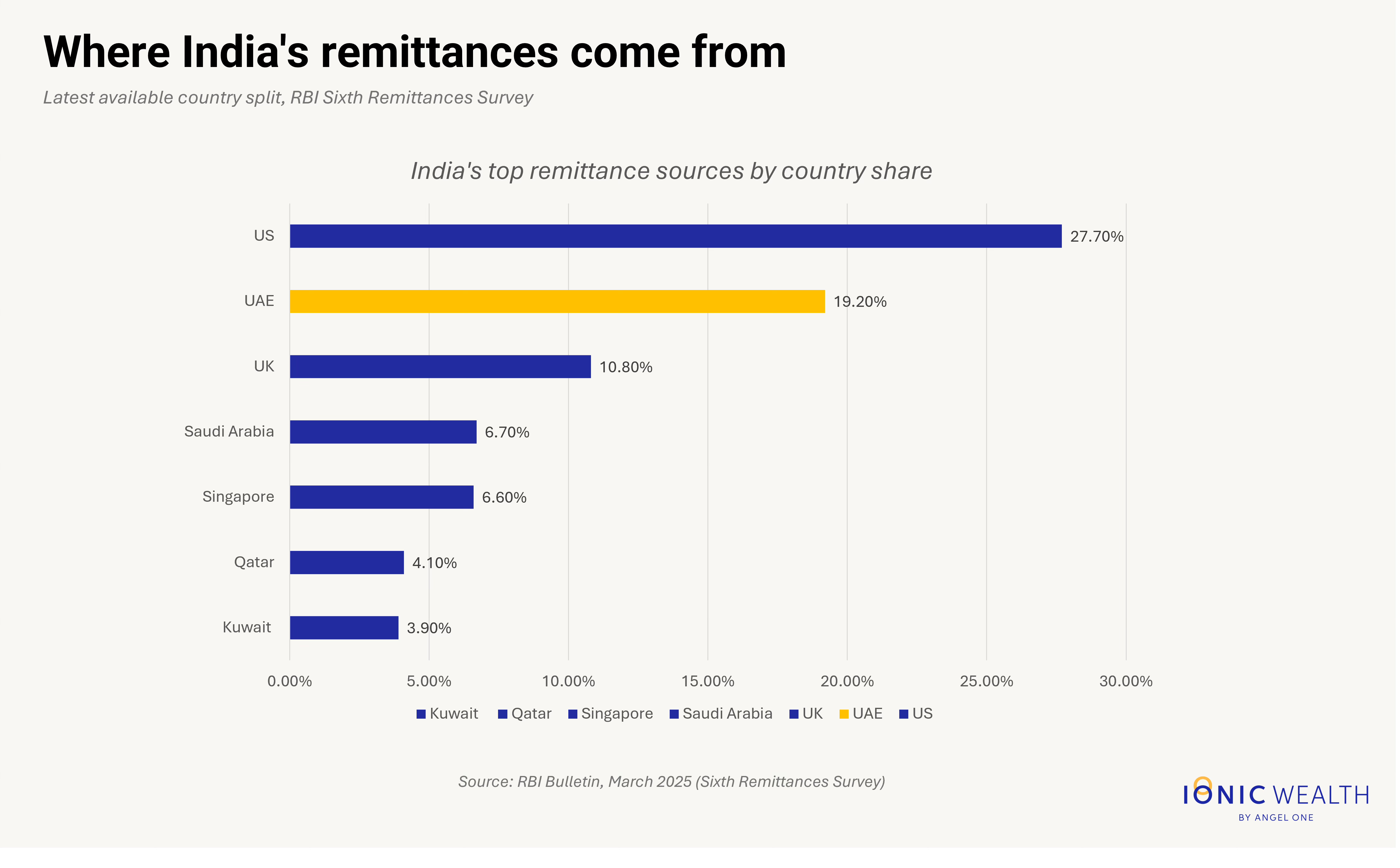
The geography of that money has been shifting. On the most recent country-level data, from the Reserve Bank of India’s FY24 remittances survey, the United States is the single largest source at roughly 28 percent, with the UAE second at about 19 percent. There are an estimated 3.5 million Indians in the UAE, and a significant proportion of them are not just sending money home for family expenses. They are making investment decisions, often jointly, as couples and families.
Yet the conversation most NRI families have with their advisors begins with what to invest in, not how to invest. Which fund. Which sector. Which PMS. The structural question, the one that governs repatriation flexibility, fund universe access, and even the currency denomination of returns, gets settled almost by accident. An account gets opened. Money flows in. And the architecture of a family’s portfolio is decided before the portfolio itself.
For Meera and Vikram, this was doubly complicated. They had not yet decided when to move back to India. Meera felt strongly that they should return before their daughter started secondary school, which gave them roughly five years. Vikram was less certain. He kept saying they should keep their options open. That unresolved family question, the kind that gets deferred over weeknight dinners and revisited on long flights home, had been quietly shaping their investment structure for years.
Two pathways, two very different architectures
There are two broad ways a non-resident family puts money to work in India. The distinction matters more than most investors realise, and it is not the distinction they usually think they are making.
The first is the onshore pathway.
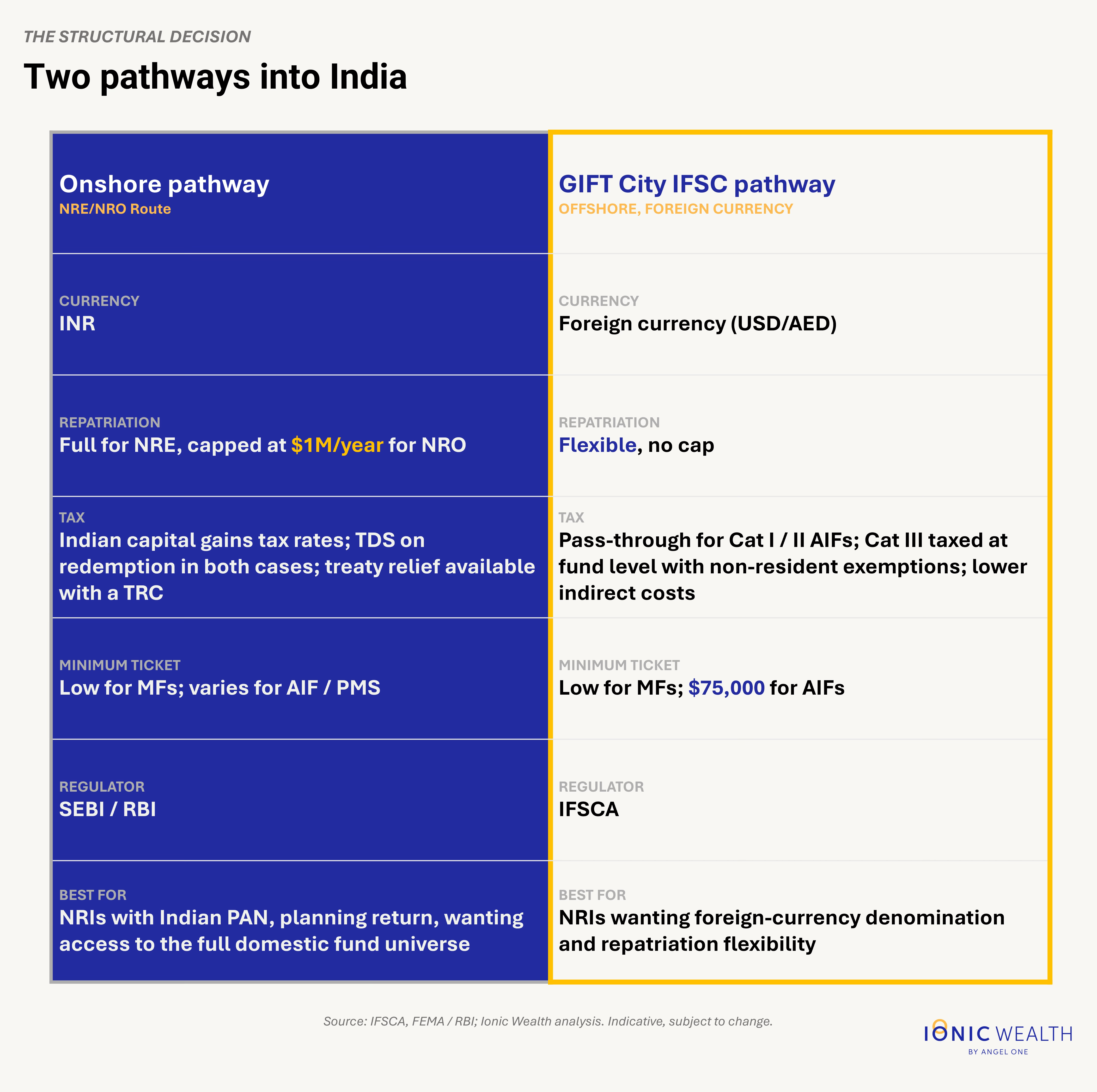
If you hold an Indian PAN and you are an NRI, PIO, or OCI, you invest in rupees through a Non-Resident External (NRE) or Non-Resident Ordinary (NRO) bank account. This is what most Dubai-based NRI families default to, because it is what their Indian bank offers when they open an account.
A quick clarification: NRE and NRO are bank accounts, not investment routes. The actual regulatory routes, the Portfolio Investment Scheme for listed equity, or the non-PIS route for mutual funds and AIFs, sit on top of these accounts. The account is the wallet. The route is the road.
The mechanics are familiar. You remit dirhams, they convert to rupees, the money sits in your NRE or NRO account, and you invest from there. The critical difference between the two: NRE accounts allow full repatriation of both principal and interest. NRO accounts cap repatriation at $1 million per financial year.
Here is the point the brochures blur: tax deducted at source applies to your investment gains in both cases. When you redeem a mutual fund or an AIF, the fund house deducts TDS before the money reaches either account. The often-quoted “NRE is tax-free” line refers to interest on NRE bank deposits, which is genuinely exempt. It does not extend to capital gains on your investments
The second is the GIFT City IFSC pathway.
Here, you invest in foreign currency through a fund domiciled inside India’s International Financial Services Centre at GIFT City, regulated by the IFSCA. You subscribe in dollars or dirhams, your returns stay in foreign currency, and repatriation is flexible by design. The minimum ticket depends on what you buy. GIFT City mutual funds start low, in the hundreds of dollars. AIFs require a minimum typically around $100,000, with Accredited Investors able to enter some structures at lower thresholds.
The tax treatment inside GIFT City is genuinely favourable, but it is not uniform. Category I and Category II AIFs are full pass-through taxation structures, with income flowing to investors without tax at the fund level. Category III AIFs are different: they are taxed at the fund level, with specific exemptions for non-resident investors on certain securities.
The document that changes the maths for a UAE family
For Meera and Vikram, there was a second insight waiting underneath the first, and it is one that most NRI families in the Gulf never have explained to them.
The UAE is a zero income tax jurisdiction. India and the UAE also have a tax treaty. Under that treaty, capital gains on Indian mutual fund units earned by a UAE tax resident are, in many cases, taxable only in the UAE, which taxes them at nothing. The reason is technical but settled: mutual fund units are not “shares,” so they fall under the residual clause of the treaty, and recent tribunal rulings involving UAE and Singapore residents have reaffirmed this reading.
The benefit is real. It is also not automatic. To claim it, a UAE resident needs a valid Tax Residency Certificate from the UAE authorities and must file Form 10F, then disclose the position in an Indian tax return. The fund house will usually deduct TDS on redemption by default; the exemption is then either pre-empted by submitting the documents before redemption, or reclaimed afterward by filing. There is a timing wrinkle worth knowing: UAE certificates are typically issued for the previous year, so the paperwork has to be planned around redemption dates, not scrambled together afterward.
This reframes the entire decision. The choice between the onshore pathway and GIFT City is not, for a UAE family, a simple choice between “taxed” and “tax-free.” With the right documentation, onshore gains can also be treaty-exempt. The real differences between the two pathways are repatriation flexibility, currency denomination, the compliance burden a family is willing to carry, and which funds each pathway opens up. The tax question is real, but it is downstream of the documentation question. And the documentation is something within the family’s control, if someone tells them in time.
The fund universe is not the same on both sides
This is the part most NRI families discover too late. The pathway you choose does not just affect repatriation and paperwork. It often determines which funds you can access.
Not every AIF or PMS will onboard a non-resident investor, and the rules can differ by country of residence. A Dubai-based NRI’s access is broader than that of a US-based or Canada-based NRI in most cases, largely because of the additional regulatory burden some fund houses choose not to take on for American and Canadian investors. But product-level restrictions exist even for Gulf-based families.
Conversely, GIFT City is producing a growing roster of strategies from credible Indian fund houses, including flexi-cap equity, long-short, and private market access, built specifically for the non-resident investor. The product gap between the two pathways is narrowing, but the structural differences, repatriation, currency, compliance, and access, still depend on your residency, your tax jurisdiction, and your liquidity timeline.
The question that should come first
When Meera and Vikram finally mapped their portfolio against their actual priorities as a family, three things became clear.
First, they had to answer the question they had been deferring: when are we going home? Not approximately. Not eventually. A real number. Because the route that makes sense for a family returning to India in five years is not the same route that makes sense for a family staying in the Gulf for fifteen. They landed on five years. Meera’s instinct about their daughter’s schooling became, for the first time, a financial input and not just a family conversation.
Second, their tax residency in the UAE was not just a tax fact, it was a planning asset they had been leaving unused. The treaty relief was available to them. They had simply never been told to get the certificate, file the form, and time their redemptions accordingly. For a family with Rs 4 crore deployed, that single piece of administrative discipline was worth more than most fund-selection decisions they had agonised over.
Third, the decision about which fund to invest in was downstream of the decision about which route to invest through. Choosing a high-conviction equity AIF through an NRO account when a GIFT City equivalent existed was not a portfolio decision. It was an unforced structural error. And they would never have seen it if they had not first agreed, as a family, on the timeline.
None of this required exotic financial engineering. It required asking the right question at the right time.
Back to the Business Bay office
Their advisor did not tell them to sell everything and start over. That would have been costly and unnecessary. What they did was restructure future allocations around the family’s shared five-year horizon. New capital would be routed through the channel that matched their residency, their timeline, and their repatriation needs as a household. Existing investments would be held to maturity where the lock-in made that sensible. And the TRC paperwork went on the calendar, not the someday list.
The portfolio itself did not change dramatically. The architecture around it did. And it started not with a spreadsheet, but with a conversation over dinner that had been three months in the making: when are we going home?
For the roughly 3.5 million Indians in the UAE, and for the broader diaspora that sends more than $136 billion home every year, this is the conversation that needs to happen before the first rupee moves.
Not which fund. Not which sector.
But which pathway, and what it means for the family in the years ahead.

Meera and Vikram are fictional composite characters based on multiple client interactions.