
What makes an AI model an effective financial tool?
Every AI model knows finance. Ionic Wealth AI knows your finances.

A team of doctors was halfway through an operation when the heart monitor went flat. Everything was going smoothly, and the tumour was also out. They thought the heart monitor’s lead had fallen off. It took 5 seconds to realise that the problem was not the lead; the doctors could not feel the pulse at all.
There were only a few minutes left to save the patient; the nurse shouted ‘Code Blue’. Among those who came to help was a senior anaesthetist, who happened to be in the same room. He asked the doctors in charge if they had done anything different in the last 15 minutes.
And there it was. They had given potassium to the patient. But by mistake, they injected a dose a hundred times the intended concentration. An overdose of the chemical was a classic cause of ‘cardiac arrest’.
Now they knew exactly what went wrong. And they did everything to reduce the concentration of potassium in the body, using medicines, glucose and injections. The potassium levels dropped, and the patient was revived.
In his book ‘The Checklist Manifesto’, Dr Atul Gawande1 says that most mistakes are avoided in similar ways. The two-step framework applies to almost all things:
Having the knowledge to solve a particular problem
Identifying the problem, so that the knowledge can be applied correctly
In the operation theatre, everyone knew what to do when a potassium overdose caused ‘cardiac arrest’. But for that knowledge to become useful, the anaesthetist had to first identify that potassium was the issue. CPR would not have helped.
Artificial Intelligence (AI) models are getting better at addressing the first problem as they scrape more and more data. However, they still need human intervention when it comes to the second step in that framework.
A few lines of prompt are not enough to give insight about the person typing behind the screen. This is why LLM models like Claude, ChatGPT, Gemini, and Grok are not entirely ‘intelligent’ when it comes to solving personal finance problems. At least not yet.
Where AI financial advice fails
In 2023, Jerry Bell, Victor Haghani, and James White of Elm Wealth2 ran an experiment called the “Crystal Ball” challenge. Their aim was to put Nassim Nicholas Taleb’s theory to the test:
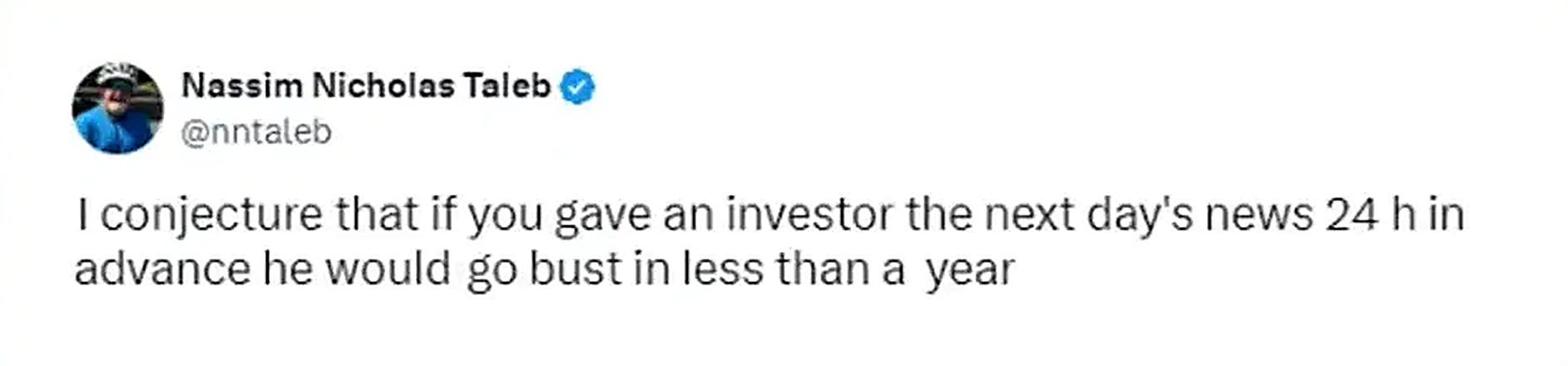
The researchers decided to see how people performed when given tomorrow’s news in advance and asked to trade on that information. The study had three cohorts: experienced macro traders, finance graduates, and ordinary people.
Participants were shown the front page of the next day’s Wall Street Journal, with any market movement blacked out, and asked to trade stocks and bonds based on it. In other words, they had a crystal-clear view of tomorrow’s events but no idea how the market would react. Each participant started with a virtual $1 million and could use up to 50x leverage.
In 2026, they updated the study to include another cohort: AI models. What the researchers found was pretty interesting. It turns out that the AI models were generally good at predicting where the markets would go. However, they consistently used a lot of leverage. Two of the four models lost money. More importantly, they could have been one trade away from a catastrophic loss due to their high leverage with each trade.
Prompt given: Please play the game as if you are a typical middle-aged, wealthy investor in the United States. The starting bankroll represents 100% of your financial wealth; you have pension income covering your subsistence needs, and there are no taxes.
Any junior analyst would have guessed that the objective wasn’t just to maximise returns. It was to preserve capital and avoid too much volatility. The generic AI models were smart at predicting the direction of stock and bond prices but had little context about the person behind the screen.
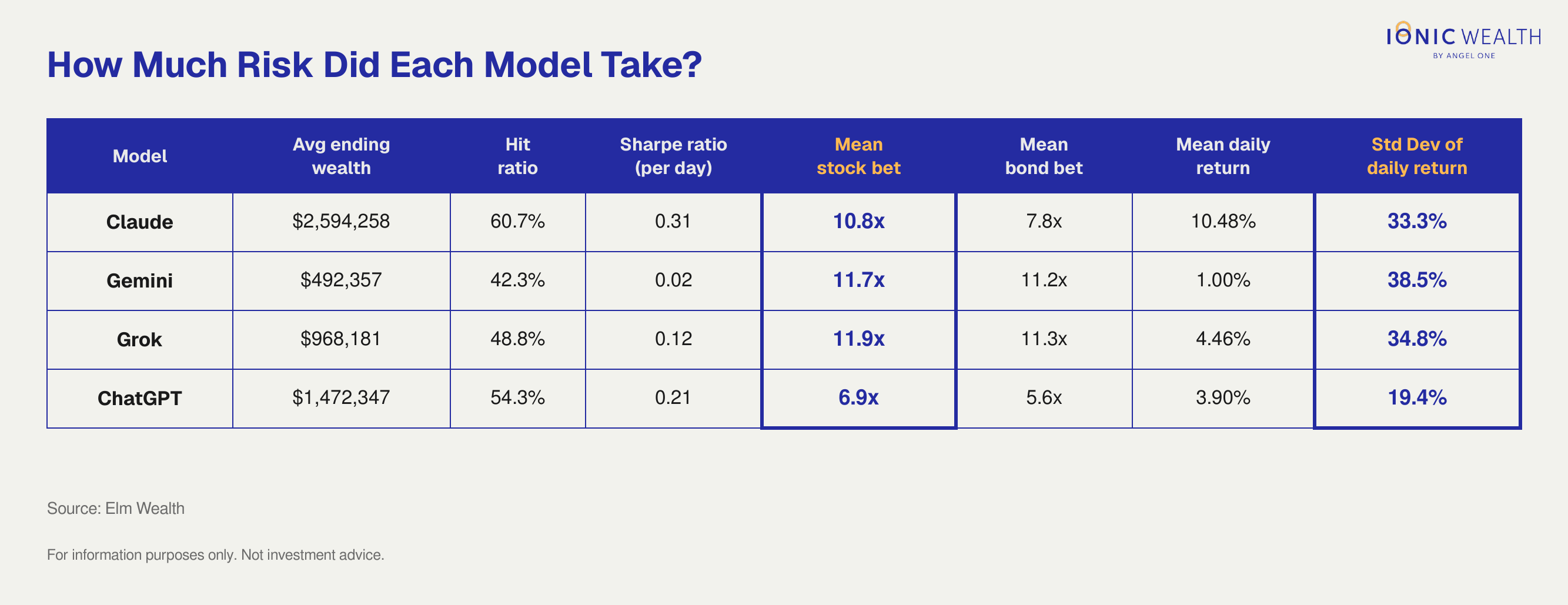
That’s like consulting a doctor who knows the treatment of every disease, except he doesn’t know what the patient is suffering from. That’s how a typical gen-AI model reacts when you ask for financial advice.
Is there a better way to use AI?
Remember, the senior anaesthetist asked the other doctors if they had done anything unusual around 15 minutes before the cardiac arrest. That’s how he got to know of the potassium overdose. Similarly, what if we could feed as much context as possible to the AI model and then, with that context, tell the AI to give answers?
So, here’s what we did with Ionic Wealth AI. We plugged the backend computational power of Claude and tried to combine it with as much data about the user before asking questions. The aim is to let the model understand the user’s background so that it produces the most relevant answers.
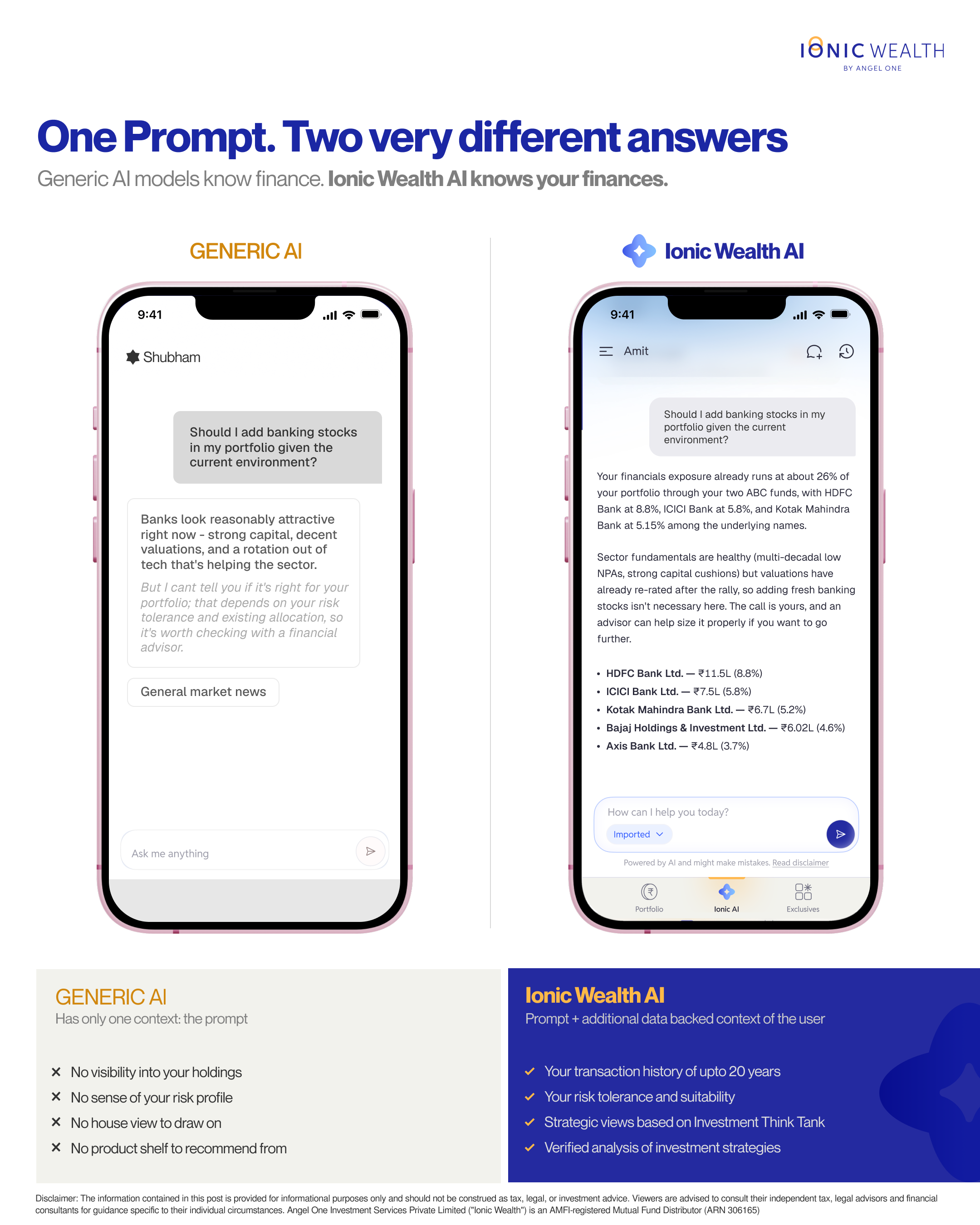
Your total investments: We pull the holdings and transaction details of users across 6 asset classes: MFs, stocks, bonds, AIFs, PMS and unlisted shares. This can be done with a few OTPs and a few clicks using MF Central, account aggregator (AA), statement uploads and internal data.
Real user example: From one user, we have pulled 9,735 transaction details. The model can trace up to 20 years of data.
Risk mandate: We also take a detailed questionnaire to judge what kind of an investor the user is and their ability to stomach risk. Around 15 questions are asked to judge the user’s risk appetite and align it with their goals. One question is how the user reacted to the Covid crash to help the model understand their risk tolerance. The user can’t lie to the system, since we now have details of what they actually did :)
Monthly outlook: We also add a layer of human judgement to the model. For instance, Ionic’s Investment Think Tank analyses the macro environment and identifies trends across asset classes. Every month, we come up with a house view based on the research and assign broad asset class allocation based on risk bands. We don’t let the AI models make random judgements like asset allocation. Human experts review and tweak these allocations every month.
Intricate nuances: Since the model has your details, we build a layer that tailors answers to fit your profile. For instance, a generic AI model will not know if you have an accredited investor certificate, what your holding period is for tax calculation, or whether your portfolio meets the eligibility criteria to invest in certain high-ticket products. We will give answers that are relevant for you.
Our model is not just about storing your information on our servers; we have also worked continuously for two years to ensure the model can contextualise the information we give it better. It’s not simply uploading the data and leaving it at that.
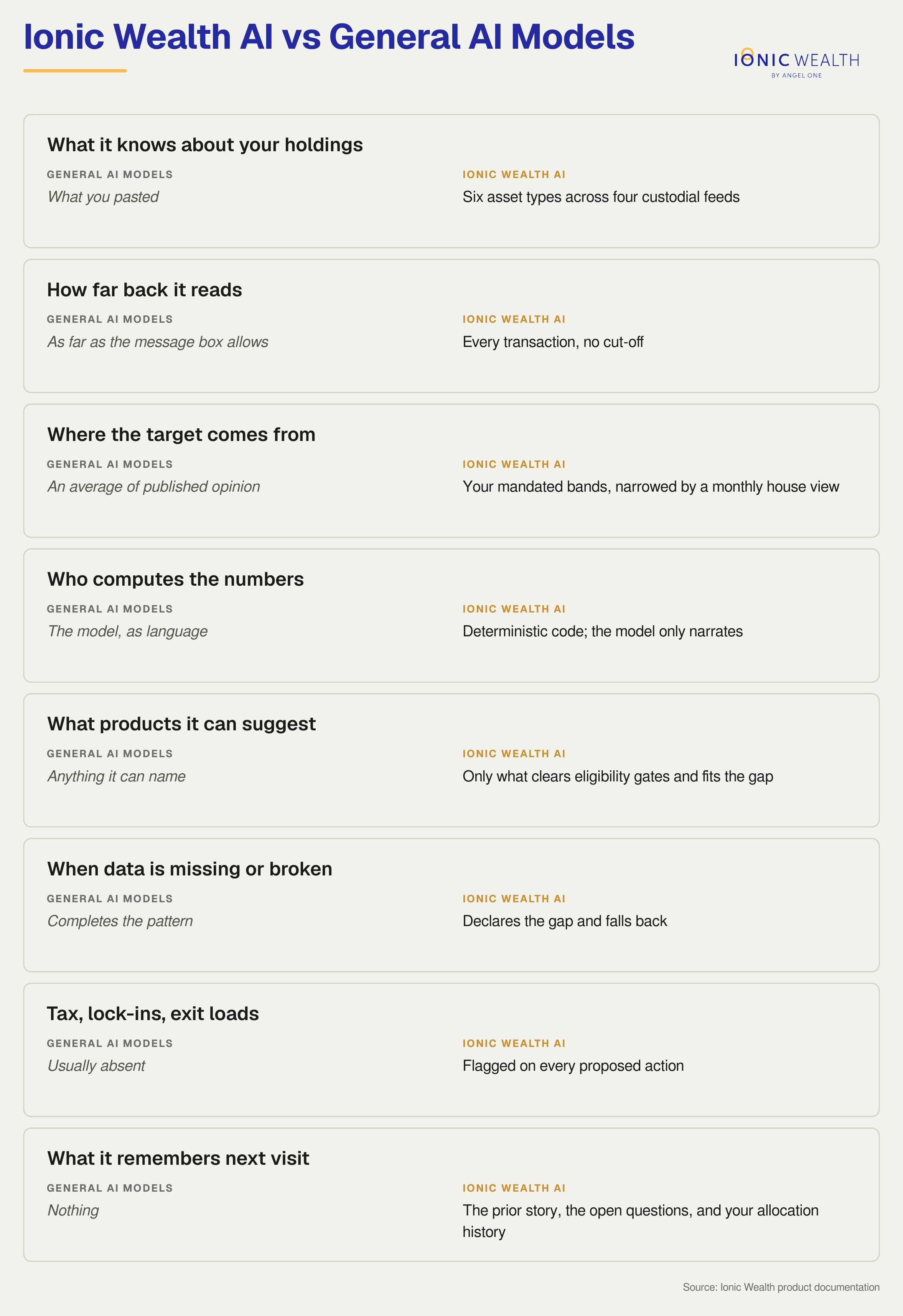
Generic AI models have another problem. Ask a calculator to solve 2+2, and it gives you 4, every single time. That’s because the rules are fixed. It’s called a deterministic engine.
AI language models work differently. They predict what word is likely to come next based on patterns they’ve picked up from their training data. That’s why they sometimes hallucinate, and the same question can get you a different answer if you ask it twice.
In finance, that’s a problem. Take CAGR or XIRR. There’s already a standard formula for calculating these, so you don’t need or want AI to guess at it. We have coded many such calculations using a deterministic engine.
Ways to Use This Tool
Here are a few things you can use the Ionic Wealth AI for:
Behaviour pattern: A first-time user of Ionic Wealth AI will see how their portfolio has performed over the years. With transaction data going back up to twenty years, the model is able to decipher trends and spot patterns that may have been missed by the investors themselves.
Tailored News: And when you look up the news, Ionic Wealth AI will not just explain what happened. It will tell you the impact of these happenings on your investment portfolio. A newspaper will report what has happened; a generic AI model will maybe summarise it for you more simply. But when the model knows exactly how you are positioned, it will tell you how it will affect your portfolio.
What our model will not do? Ask how much the Nifty will go up tommorow, and it’ll say it doesn’t know; it will not take a guess. Instead, it shows you how any outcome could hit your portfolio, so you’re ready regardless.
Existing concentration: Let’s say a celebrity fund manager comes on CNBC and says you should buy US tech stocks because the valuations are attractive. It’s credible advice, and the facts also support the case. However, Ionic Wealth AI may highlight that the feeder funds you hold already have allocations to tech stocks. Our model will identify such things instead of suggesting ideas without context.
Second Opinion: Another valuable way to use the Ionic Wealth AI is to input any recommendation you’ve received, whether from an Ionic Wealth advisor or elsewhere, and ask the model for its perspective. It may validate the reasoning, or it may challenge it with supporting facts. Either way, you get a credible second opinion, grounded in evidence rather than dinner-table conversation.
Do you remember how you felt the last time the markets took a sharp tumble? Don’t worry. Our model will tell you exactly what you did and what it says about you as an investor. You would be surprised to know things about yourself that you weren’t aware of.
What comes next
When the internet was launched, it gave rise to mega companies like Google, Amazon and Facebook (now Meta). Closer to home, the UPI ecosystem and cheap internet gave birth to companies like Paytm and Zomato. History has shown that when new technology arrives, it becomes raw material: the real winners are the ones who build the best use cases on top of it.
At the current juncture, everyone has access to AI. We believe the next set of winners will be decided by those who can apply the technology for the most innovative use cases. Tech alone has never been the catalyst; human judgement plays a key role.
The biggest companies, like Nvidia, understand this too. The chip manufacturing giant has partnered with the best scientists in the field to accelerate discovery and reduce the cost of developing new drugs. The compute power makes the scientists more efficient; it does not eliminate them.
That’s the same lesson from the operation theatre we started with. The anaesthetist’s knowledge of potassium overdoses was useless until he had the context to know that’s what he was dealing with.
AI works the same way. A model’s intelligence is only as good as the context layered on top of it. That’s what we’re building with Ionic Wealth AI: not a smarter model, but a better-informed one.
Before going to bed, if you ask a general AI model for the best F&O strategies to make a quick buck in the morning, it might actually give you some ideas. Ask Ionic Wealth AI, and it’ll probably tell you to get a good night’s sleep instead.
Download the app to experience Ionic Wealth AI: Here
The Checklist Manifesto | Atul Gawande
Do AIs Make Good Traders, and Do They Make Good Traders Better? | Elm Wealth