
Why a will alone won't protect your legacy
A Trust structure might work better for most wealthy families

Abhay Kumar1 has spent 30 years building a life that most people would consider the definition of success. At 58, he is a senior director at a large multinational, sits on the boards of three companies, and has accumulated a substantial estate.
That estate spans a primary residence in Mumbai, a second home in Goa, a portfolio of mutual funds, foreign equities and fixed deposits, and rental income from two commercial properties across Bangalore and Mumbai. His wife, Meena, handles much of the family’s day-to-day finances. His daughter Priya is a doctor settled in London with her British-Indian husband. His son Arjun is in Bengaluru, building a startup.
Abhay is not reckless with money. He has a will drawn up, his investments are spread wisely, he has insurance, and he is confident that his affairs are in order.
But here is the gap no one has told him about: a will, no matter how carefully written, is not built for an estate of his complexity. The consequences of relying on it alone can come up in the form of delays, disputes, tax inefficiencies and assets getting entangled in courts, all of which can undo decades of careful accumulation.
This is the story of why Abhay needs a private trust, and what that actually means in practice.
The problem with just a will
A will is a document that comes into action after you die. It outlines who gets what, and, on the surface, that sounds sufficient. But the moment it comes into effect, it may enter a process called probate, which is a court-supervised exercise where the will is validated, creditors are given a chance to file claims and assets are distributed to heirs. While probate is no longer mandatory, Abhay’s will may still need a probate as the assets are spread across different states and there is cross-border inheritance involved.
Probate is slow and can take months, sometimes years. During that period, Abhay’s family will have limited access to his estate. More importantly, probate is public, and anyone can look up the proceedings and know exactly what he left behind and to whom. For a family of Abhay’s standing, that exposure is far from ideal.
Secondly, a will, in most cases, only distributes assets, but cannot manage them. The moment Priya and Arjun receive their inheritance, the money is entirely in their hands. Abhay cannot, through a will, ensure that his daughter’s share stays insulated from a potential divorce settlement in the UK. He cannot ensure that his son, who is in the middle of building a startup, does not have his inheritance vulnerable to business creditors. And if Abhay were to unfortunately suffer from a medical emergency like a stroke, or something that impairs his cognitive ability, a will offers the family no direction because wills only come alive after death.
These are some of the structural limitations of a Will for a complex estate, which is better structured through a Trust.
What a trust actually is
In simple terms, a private trust is a separate legal entity that holds and manages assets on behalf of named beneficiaries, according to the rules laid out by the person building the trust.
There are three key roles involved in a trust.
The settlor is the person who creates the trust and transfers assets into it, which is Abhay in this case.
The trustee, who is the person or institution that legally holds and manages those assets, is bound by a strict obligation to follow the terms of the trust deed.
The beneficiaries who ultimately receive the benefit of those assets–Meena, Priya, Arjun and perhaps their children.
Since trust is a separate entity, it changes how the settlor owns and controls the assets in it. The moment Abhay transfers his assets, both movable and financial, into a trust, they are no longer in Abhay’s name personally, and legal ownership moves to the trust. This may sound alarming, but the degree of control Abhay will continue to have depends on whether he makes a revocable or an irrevocable trust.
The two structures of revocable and an irrevocable trust not only determine how much control you are willing to give up, but also come with distinct benefits.
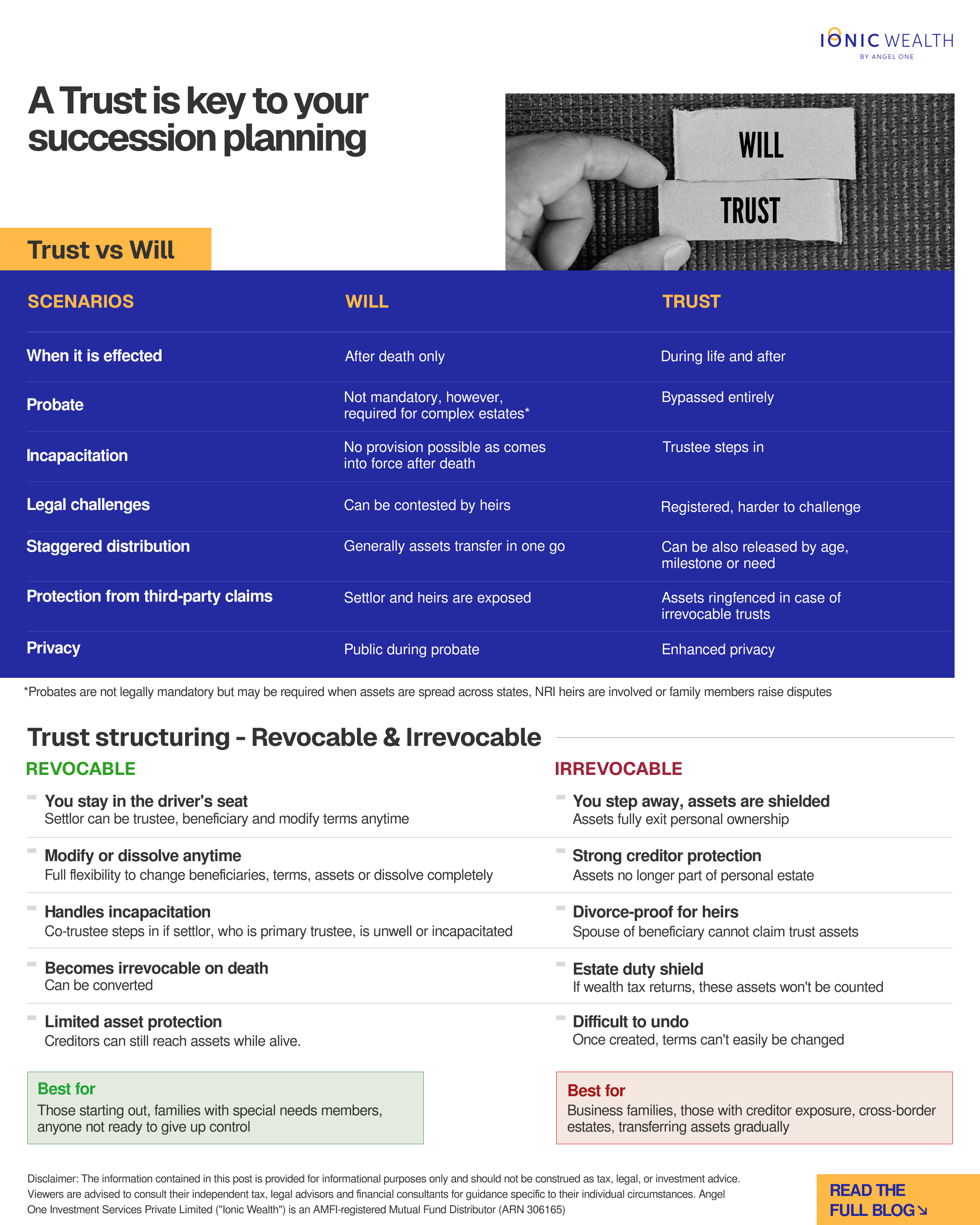
Revocable & irrevocable trusts
In a revocable trust, he can simultaneously be the settlor, the managing trustee and a beneficiary. He retains full operational control over his assets, can change the terms as family circumstances change, add or remove beneficiaries, can take out assets if needed, or even dissolve the trust entirely if he wants. The legal ownership is transferred to the trust, but Abhay continues to call every shot.
He can appoint his spouse, Meena, as co-trustee, so that she can step in if he is diagnosed with a serious illness and can no longer make decisions, something which a Will is incapable of addressing.
A trustee does not necessarily need to be the settlor or any person, for that matter. Wealthy families often appoint a corporate trustee, which is a professional institution that acts as trustee and is especially useful when a family wants checks and balances beyond what a single individual can provide.
An irrevocable trust is a different proposition. Here, the settlor transfers assets out of personal ownership permanently. The trade-off is insulation from creditors, from divorce claims and potentially from estate duty or wealth tax, if it gets reintroduced in India, as has been discussed in recent years.
For business families or anyone with exposure to large creditor liability, an irrevocable trust built well before any litigation arises can be a powerful protection. For instance, if his son Arjun’s business accumulates debt and creditors come knocking, his personal assets, including any inheritance he has already received, could be vulnerable. Inside an irrevocable trust, assets earmarked for Arjun are not his personal property yet, as they are held by the trust. A creditor cannot seize what Arjun does not legally own.
His daughter Priya’s situation raises a different concern. She is married and lives in the UK, a jurisdiction with its own matrimonial property laws. If her marriage were to face difficulties, a divorce proceeding there could pull in assets that Abhay intended only for his daughter. With a properly structured trust, Priya’s share remains in the trust and is not considered her personal asset, which means her spouse cannot claim these as part of a matrimonial settlement. This protection has been tested in Indian courts and upheld in cross-border cases as well.
It should be noted that timing matters when it comes to the protection of assets from marital disputes and creditors. A trust created genuinely for succession planning purposes, and not hastily assembled after a divorce filing has already begun, gets full insulation. Courts and tax authorities look at the intent and the timeline.
The same logic applies to creditor protection. A trust built in anticipation of an impending lawsuit will not be treated as legitimate. One built as a long-term estate planning instrument will hold.
For Abhay, a commonly advised structure is a revocable trust now, with the trust deed drafted to automatically become irrevocable upon his passing. This way, he retains full control while alive, and the estate gets full protection when he is gone.
The cross-border dimension
Because his daughter Priya lives in the UK, Abhay’s estate has a cross-border dimension that a simple will is entirely unequipped to handle. Even though India does not currently impose estate duty, reintroducing wealth tax has been a recurring subject of policy discussion. A trust structure already in place would provide insulation in both scenarios.
There is also a practical compliance dimension. As long as Priya is named as a contingent beneficiary in the trust rather than the primary beneficiary, she has no immediate reporting obligation to ‘His Majesty’s Revenue and Customs’ (HMRC), the primary non-ministerial department of the UK government responsible for collecting taxes in the UK. She is not the owner of any asset, but rather a future recipient, subject to conditions. The moment Abhay’s estate passes to her directly through a will, however, those assets form part of her global wealth and are subject to full disclosure. Most other Western countries have such laws for inheritance or estate tax.
Further, if Abhay is to only make a will, Priya would most likely have to get a probate to repatriate her inherited money or sale proceeds of inherited assets, as foreign banks and institutions ask for a court seal on a will.
Keep in mind that an Indian trust can technically hold foreign movable assets like stocks, bank accounts, and bonds, but it faces practical limitations for foreign immovable property like real estate. Property abroad is governed by the lex situs principle, meaning the law of the country where the asset is located takes precedence. For this reason, creating a separate trust or legal structure in the jurisdiction where the foreign assets are located is advisable, rather than relying solely on an Indian trust.
How trusts are taxed in India
The income tax laws treat a trust as a taxable unit with its own PAN, its own bank account and files its own income tax return in ITR-5. While Abhay is alive and the trust is revocable, all income from assets in the trust, such as rental income, dividends, and interest, is taxed in his hands personally, as per Section 61 of the Income Tax Act.
After Abhay passes, taxation depends on the structure of the trust. If the trust is a specific or determinate trust, meaning each beneficiary’s share is clearly defined from the beginning, the trustee is taxed as a representative assessee in the same manner and to the same extent as the beneficiaries would have been taxed on their respective shares of income.
If the trust is a discretionary trust, meaning the beneficiaries or their interests are not defined in this structure, all income is taxed at the maximum marginal rate (MMR), currently around 39%/42.74%, including surcharge and cess. This structure comes in handy if there are divorce proceedings or credit liability underway, as neither can claim a share, as it’s not defined who gets what and when. However, the government taxes it at MMR because when the beneficiaries are not defined, it is assumed it is the wealthiest possible person and taxed accordingly. So, a specific trust with clearly defined shares is a more tax-efficient choice.
The other case where the trust, even if determinate, is taxed at MMR rate is when any type of business income is included in the trust. For example, a property that is listed on Airbnb is included in the trust. Or say the family members are shareholders in their own business and transfer their shares to the trust.
Further, transferring real estate properties in the trust attracts stamp duty. This is because the transfer of legal title is treated as a new transaction. To avoid this, Abhay can follow the more common and accepted structure of keeping the properties in his personal name and handling them through his will, with the will directing that the properties pass into the trust upon his death. That way, the title mutation happens only once, at the time of his passing, and subsequent generations are spared from repeating the exercise at every transfer.
What Abhay should do
Abhay is at exactly the age when putting off succession planning can become a real risk for him. Cognitive decline, sudden illness, a business dispute or a family situation he cannot anticipate cannot be addressed by a will alone.
The right starting point is a conversation with an estate planning advisor who can map his assets, understand his family’s specific situation and draft a trust deed that addresses each of his family’s dimensions–Arjun’s startup risk, Priya’s cross-border exposure, Meena’s continued comfort and the generation after that.
While a will defines what to divide after you are gone, a trust helps to protect everything you have built while you are still here to make those decisions well.

Abhay Kumar and his family are composite fictional characters created for illustrative purposes.